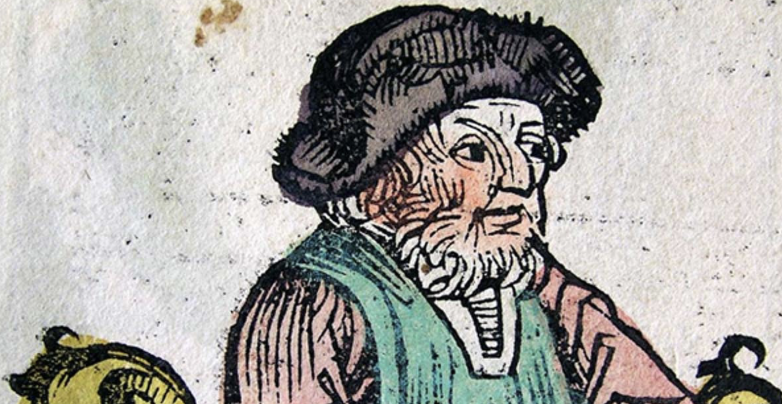
Among the early thinkers of ancient Greece, few are as quietly influential as Anaximenes. Living in the 6th century BCE in the Ionian city of Miletus, he stood at the crossroads between myth and reason. While earlier generations explained the universe through the actions of gods, Anaximenes sought something radically different: a rational, observable principle that could explain everything.
He proposed that the fundamental substance of the universe — the arche — was air.
At first glance, this may sound simplistic. But in the intellectual climate of his time, it was revolutionary.
From Myth to Mechanism
Anaximenes followed in the footsteps of Thales and Anaximander, fellow Milesian philosophers who had already begun the search for a unifying principle of reality. Thales identified water as the source of all things. Anaximander suggested the apeiron, an indefinite and boundless substance.
Anaximenes chose something more tangible: air — invisible yet everywhere, essential yet subtle.
What made his theory powerful was not merely the choice of air, but the mechanism he proposed. According to him, all things emerge through processes of rarefaction and condensation. When air becomes thinner, it transforms into fire. When it becomes denser, it turns into wind, clouds, water, earth, and eventually stone.
In other words, diversity in the universe is not the result of divine whim, but of physical transformation. Change follows an intelligible pattern.
This marked one of the earliest attempts to describe nature in terms of process rather than myth.
The Soul and the Universe
Anaximenes did not treat air as a mere physical element. He observed something deeply human: breath sustains life. Without air, the body perishes.
He famously suggested that just as our soul — understood as breath — holds us together, so too does air encompass and sustain the entire cosmos. The microcosm mirrors the macrocosm.
This idea would later echo in Stoic philosophy through the concept of pneuma, a vital breath that permeates reality. Though centuries apart, the intellectual lineage is clear: Anaximenes planted seeds that would grow in later philosophical systems.
A Naturalistic Cosmology
In his cosmology, the Earth was described as a flat disc floating upon air, and celestial bodies were formed through transformations of condensed air. While modern science has long moved beyond these models, the significance lies elsewhere.
Anaximenes attempted to explain the structure of the universe without invoking supernatural intervention. He trusted observation and logical reasoning. The world, he believed, could be understood through consistent principles.
That shift — from divine storytelling to rational explanation — is one of the defining moments in Western intellectual history.
Why Anaximenes Still Matters
Today, we understand matter in terms of molecular structures and states — solid, liquid, gas, plasma. Strikingly, Anaximenes’ idea that qualitative differences arise from quantitative changes (density) anticipates this insight in a primitive yet profound way.
He recognized that transformation does not require entirely new substances; it can arise from variation within a single underlying reality.
This intuition — that unity underlies diversity — continues to shape philosophical and scientific thought.
The Quiet Revolutionary
Unlike the dramatic figures who would follow — Socrates questioning morality, Plato constructing ideal forms, Aristotle cataloging the sciences — Anaximenes worked with elemental simplicity. Yet his contribution was foundational.
By identifying a material principle and explaining change through natural processes, he helped build the framework within which philosophy and science could later flourish.
Air, in his vision, was not empty space. It was structure, life, continuity — the unseen thread binding all existence together.
And in that invisible breath, the earliest stirrings of scientific thinking began.
'7. English BLOG' 카테고리의 다른 글
| Menopause Weight Gain: 7 Proven Ways to Lose Belly Fat After 45 (0) | 2026.02.21 |
|---|---|
| Heraclitus and the Fire of Becoming: The Philosopher of Eternal Change (0) | 2026.02.19 |
| The Truth About Losing Belly Fat: What Exercises Actually Work? (1) | 2026.01.22 |
| Foods You Should Never Eat on an Empty Stomach: Hidden Health Risks You Should Know (1) | 2026.01.13 |
| The Truth About Detox Diets (1) | 2026.01.09 |


